Three Forms.
Three Jobs.
Nothing In Here Is Decoration.


You have taken magnesium before. Probably more than one kind. Two things decide whether it does anything at 3AM, and neither one was printed on the bottle you already tried.
Around half of women over 40 get less magnesium than they need. Average intake: 269mg a day.

It's the cheapest form to make, so it fills most of the shelf. The label wasn't lying about what was in the bottle. It just never mentioned how little of it reached you.

"1,000mg" means the compound. The actual magnesium is 11–16% of that. So a bottle can print a number nine times bigger than your real dose, and say nothing false.

Citrate pulls water into the bowel. Most blends use too much of it. That wasn't a bad reaction to magnesium — it was one form, at a dose nobody sized for a woman with a job.

It builds over one to four weeks, not one night. If you quit on day five, you followed the only instructions you had. There weren't any.
You fall asleep fine. That's the part everyone misses. Falling asleep and staying asleep run on two different systems — and only one of them is running low.
Magnesium is what your nervous system uses to hold the brakes on overnight. In your twenties you refilled it daily without thinking about it. In your forties, four things start pulling it the other way.
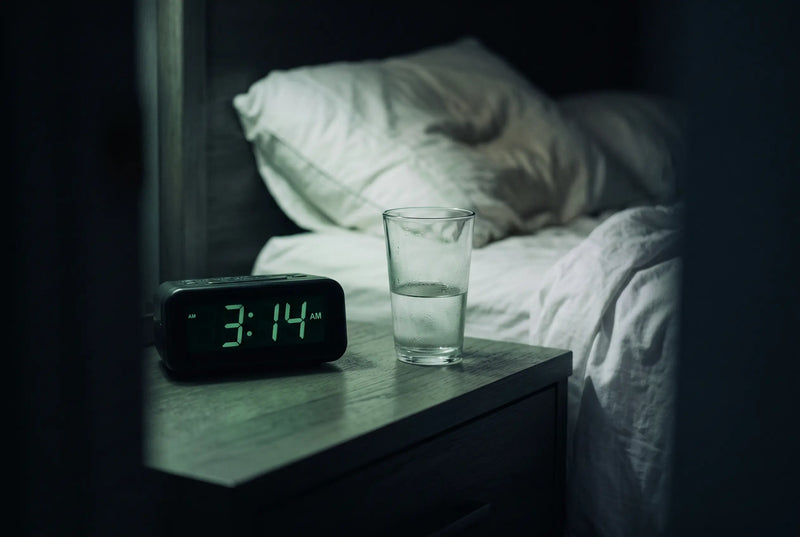
Meanwhile your cortisol rise begins in the early hours — that's normal, it's what wakes you up. What isn't normal is having nothing left to hold it steady when it starts.
So it arrives unopposed, at 2AM, at 3AM, at 4AM. Heart pounding. Mind already going. Wide awake and bone-tired at the same time.
A sedative forces the screen dark while everything underneath keeps draining. That isn't the problem you have. You don't need to be knocked out — you need the battery refilled.
Every figure below is public. Sources are available on the web.
Every figure below is public. Sources are available on the web.
National intake data, before perimenopause is factored in
Against a recommended 320mg. The gap is the story.
The form in most budget bottles, including the one you tried
The same dose used in the strongest recent sleep trial
Three of those numbers describe the problem. The fourth is the only one we control.

Nothing In Here Is Decoration.
Glycinate is absorbed through the amino acid pathway, not the osmotic one — meaning it goes into you rather than through you. It's the form the menopause forums settled on years before the supplement industry caught up, and it's the hero here for one reason: it's the only one you can take every single night without thinking about where the nearest bathroom is.
Malate is magnesium bound to malic acid, which your cells use in energy production. It's here so the whole formula isn't betting everything on the night. Broken sleep costs you the following morning too — the fog, the 3pm wall, the aching legs — and this is the part aimed at that half of the problem.
Citrate is why most people quit magnesium. It's absorbed osmotically — it pulls water into the bowel — and most blends use far too much of it. We kept it small on purpose: enough for absorption diversity and gentle regularity, far below the amount that sends you to the bathroom. This is the number we'd want you to check first.
Most bottles print the compound weight, because it's a bigger number. We print both. The total sits at the dose used in the strongest recent sleep research, and comfortably under the 350mg supplemental upper limit. That's the whole formula. There's no proprietary blend, because there's nothing in here we'd need to hide inside one.


Magnesium for the wake-up, not the falling asleep.
You fall asleep fine. That was never the problem. Nocturyl is built for the other half of the night — the 2 to 4AM jolt, heart going, mind already running, four hours before the alarm.
Three forms, each there for a reason:
Glycinate — the hero. Absorbed through the amino acid pathway, not the osmotic one, so it goes into you rather than through you.
Malate — the daytime half. Supports next-day energy and muscle comfort.
Citrate — deliberately small, around 50mg elemental. It's the form that sends people to the bathroom. Most blends use several times this.
250mg elemental magnesium per serving. Printed in the only unit that matters. Most bottles print the compound weight because it's a bigger number. No proprietary blend — every form listed with its own dose.
What it isn't: a sedative. It won't knock you out and it won't work the first night. The improvement builds over one to four weeks, strongest in people who were low to begin with — around half of women over 40.
1 - 2 capsules, 30 to 60 minutes before bed, every night. 90 vegan capsules, 45 servings.
This statement has not been evaluated by the FDA. This product is not intended to diagnose, treat, cure, or prevent any disease.
You've been sold enough things that promised everything. So here are the limits, stated plainly, while you can still walk away. If any of these are dealbreakers, we'd rather you knew tonight than found out in week three.

This isn't a sedative and it doesn't work like one. There's no drowsy switch, no heaviness, no fighting it off at 9pm. If what you want is to be put under, this is the wrong product — and an antihistamine is the wrong one too, just faster about it. Which is why there's no next-day grogginess

In the trials, the improvement builds across roughly one to four weeks. You're refilling something, not taking something. Most people notice somewhere in weeks two to four.

The strongest recent trial on this dose found a genuine improvement over placebo — and described the effect size as small. It was largest in people who were low to begin with. We'd rather show you that sentence than hide it.

It's a mineral, not a hormone. It doesn't replace HRT, it isn't a treatment for anything, and it won't touch a symptom that isn't related to magnesium status.
This isn't us against other brands. It's the four kinds of magnesium a woman over 40 typically ends up with, and what separates them. Check ours against the label in your hand.
This isn't us against other brands. It's the four kinds of magnesium a woman over 40 typically ends up with, and what separates them. Check ours against the label in your hand.
Every row below is something you can check yourself, tonight, on a label you already own. That's deliberate. We didn't pick criteria we happen to win on — we picked the ten things that separate a magnesium that works from one that sits in a drawer, and then made sure we could pass all of them before we printed the table.
Three rows are worth the extra second. Elemental magnesium on the label is the one almost nobody prints, because the compound number is bigger and more flattering. Citrate kept deliberately small is the reason most women quit magnesium in week one, and it's the number we'd want you to compare first. And honest timeline stated upfront is where the category tells you "fast-acting" and we tell you two to four weeks — which is slower, less exciting, and true.

|
Others
|
|
|---|---|---|
|
Elemental magnesium on the label
|
||
|
Every form listed with its own dose
|
||
|
No proprietary blend
|
||
|
Glycinate as the main form
|
||
|
Citrate kept deliberately small
|
~50mg | Often 5x that |
|
Third-party tested, COA published
|
||
|
Gentle enough for every night
|
||
|
Next-day energy support included
|
||
|
Built for the 3AM wake-up
|
Nothing in that column is a formulation secret. It's just what happens when nobody's counting on you not to read the label.
You're refilling something that took years to run down, so the first week is quieter than you'd like. Here's roughly how it goes, based on the trial data and what most people report. Take it nightly — the consistency is the part that does the work.
You may notice you settle a little easier, or you may notice nothing at all. Neither means anything yet. What matters this week is only that you take it every night, including the nights you feel fine.
For most people the first change isn't fewer 3AM wake-ups — it's that getting back down takes twenty minutes instead of two hours. It's easy to miss. Worth writing down, because you'll forget how bad last month was faster than you expect.
This is usually where the next-day half shows up: the 3pm wall arriving later, the word you were reaching for arriving faster, the fuse being fractionally longer than it was. Often other people notice this before you do.
By the end of the first month you'll have a real answer, which is more than a five-night trial could ever have given you. If it's working, this is roughly the level it works at. If it isn't, you're still inside the guarantee and we'll refund the bottle you've already opened.
This isn't a course you finish. Magnesium is something you use daily and lose daily, and the reasons you were running low haven't gone anywhere. Stop, and you drift back toward where you started — usually slowly enough that you won't connect the two.
Every review here is from a verified buyer and nothing has been removed. You'll find people it worked for, people it took five weeks to work for, and people it didn't work for at all. That last group is small, and we'd rather you read them than wonder what we deleted.


Nocturyl Glycinate 3-in-1 — Nightly Magnesium for the 3AM Wake-Up
$69.99

Nocturyl Glycinate 3-in-1 — Nightly Magnesium for the 3AM Wake-Up
$69.99

Nocturyl Glycinate 3-in-1 — Nightly Magnesium for the 3AM Wake-Up
$69.99
Purchased on March 6th, 2026

Nocturyl Glycinate 3-in-1 — Nightly Magnesium for the 3AM Wake-Up
$69.99

Nocturyl Glycinate 3-in-1 — Nightly Magnesium for the 3AM Wake-Up
$69.99

Nocturyl Glycinate 3-in-1 — Nightly Magnesium for the 3AM Wake-Up
$69.99
Purchased on July 2nd, 2026

Nocturyl Glycinate 3-in-1 — Nightly Magnesium for the 3AM Wake-Up
$69.99

Nocturyl Glycinate 3-in-1 — Nightly Magnesium for the 3AM Wake-Up
$69.99

Nocturyl Glycinate 3-in-1 — Nightly Magnesium for the 3AM Wake-Up
$69.99
Purchased on March 14th, 2025

Nocturyl Glycinate 3-in-1 — Nightly Magnesium for the 3AM Wake-Up
$69.99
Purchased on May 14th, 2026

Nocturyl Glycinate 3-in-1 — Nightly Magnesium for the 3AM Wake-Up
$69.99
Purchased on April 21st, 2026

Nocturyl Glycinate 3-in-1 — Nightly Magnesium for the 3AM Wake-Up
$69.99
Purchased on May 25th, 2026

Nocturyl Glycinate 3-in-1 — Nightly Magnesium for the 3AM Wake-Up
$69.99
Purchased on June 5th, 2026

Nocturyl Glycinate 3-in-1 — Nightly Magnesium for the 3AM Wake-Up
$69.99
Purchased on March 14th, 2025

Nocturyl Glycinate 3-in-1 — Nightly Magnesium for the 3AM Wake-Up
$69.99
Purchased on March 14th, 2025
If yours isn't here, email us and we'll answer it. We'll also add it to this list.
Magnesium can interfere with the absorption of some antibiotics (tetracyclines and quinolones) and with thyroid medication, so those should be separated by two to four hours. If you take a prescription diuretic, a reflux drug, or anything for your heart, check with your pharmacist first — they'll answer in two minutes and it's worth asking.
Magnesium is a dietary mineral, not a hormone, and there's no known interaction. Plenty of women take both. Your prescriber is the right person to confirm it for your situation.
About 30 to 60 minutes before bed, every night. Consistency matters more than timing — the roadmap above explains why.
Either works. If you have a sensitive stomach, take them with a small amount of food for the first week.
Ask your doctor first. That's not us being cautious for legal reasons; magnesium needs genuinely change in pregnancy and it's a question for someone who knows your history.
Unlikely, and here's the honest version. The citrate is the form that causes it, and ours contributes roughly 50mg elemental — a fraction of what most blends use, because that's the dose that keeps it below the threshold where it starts pulling water into the bowel. The glycinate, which is the bulk of the formula, is absorbed by an entirely different pathway that doesn't have this effect. Most people notice nothing. A small number with sensitive guts still notice softer stools in the first week. We won't promise you a guarantee we can't keep.
1-2 capsules per serving/daily, average capsule size with 90 capsules per pouch, which is 90 to 45 servings. We'd rather tell you that plainly than let you find out.
There's no known direct interaction, but this is one to raise with whoever prescribed it rather than take our word for. We're not in a position to advise on your medication.
Of course if subscription exists: Any time, from your account, in two clicks. No phone call, no email, no retention offer. If you have to fight us for it, we've written the wrong page.


The roadmap above is the reason this guarantee exists. Week one is quiet. The first real change tends to land somewhere in weeks two and three. By the end of the first month you have a genuine answer — which is more than a five-night trial could ever give you.So take it nightly for 30 days. If the 3AM wake-ups aren't shorter, aren't rarer, or nothing has changed at all — email us and we'll refund what you paid. The pouch can be half empty. Keep it.We don't ask for it back, we don't ask you to prove you took it, and there's no form. One email, and it's done.
START WEEK ONE
The roadmap above is the reason this guarantee exists. Week one is quiet. The first real change tends to land somewhere in weeks two and three. By the end of the first month you have a genuine answer — which is more than a five-night trial could ever give you.So take it nightly for 30 days. If the 3AM wake-ups aren't shorter, aren't rarer, or nothing has changed at all — email us and we'll refund what you paid. The pouch can be half empty. Keep it.We don't ask for it back, we don't ask you to prove you took it, and there's no form. One email, and it's done.
START WEEK ONE


